 Ευαίσθητο περιεχόμενο

 Ευαίσθητο περιεχόμενο
 Ευαίσθητο περιεχόμενο
 Ευαίσθητο περιεχόμενο
 Ευαίσθητο περιεχόμενο
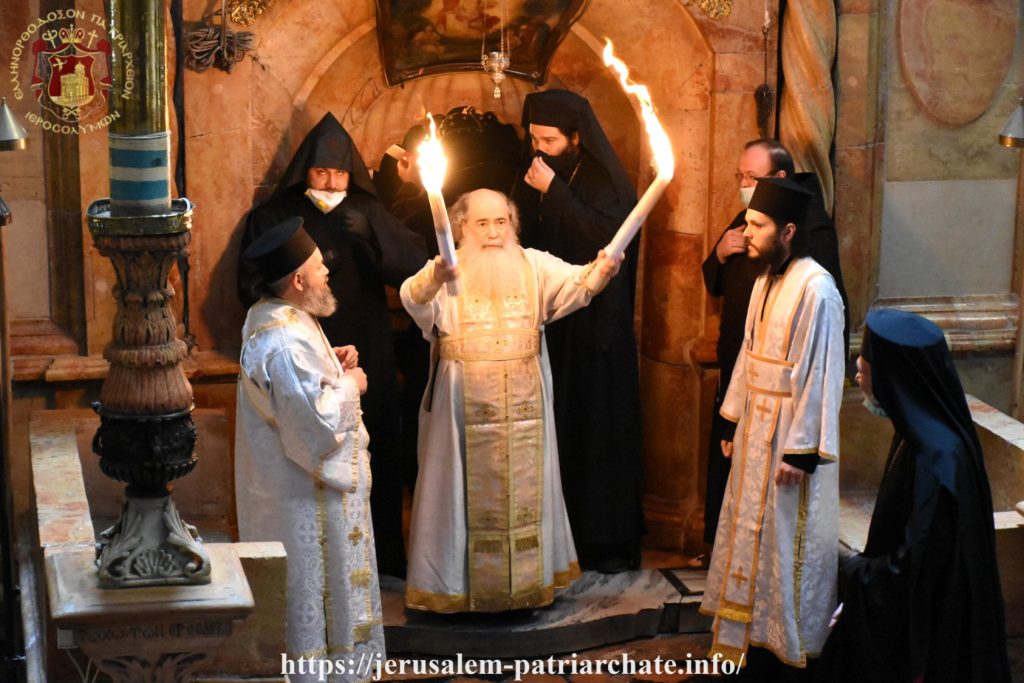
The ceremony of the Holy Fire is a major ritual of Eastern Orthodox Christianity, held every Holy Saturday at midday at the Holy Sepulchre in Jerusalem. Thousands of believers gather at the Church of the Resurrection to take part in the ceremony, during which the Greek Orthodox Patriarch of Jerusalem enters the Edicule of the Holy Sepulchre, where two oil vigil lamps have already been placed on the Tomb. After reciting a prayer of thanksgiving, he emerges holding lit bundles of candles in his hands, distributing the flame to the faithful.
Myths and narratives about how the Holy Fire is lit
A prevailing belief among the faithful, across many Christian denominations, and even within official ecclesiastical voices, is that the flame is lit in a miraculous manner. “It is about a real miracle that leaves no room for doubt.”, “Truly this is one of the greatest Miracles of Christianity that repeats every year on Great Saturday.“, it was stated for years, as we see in an earlier Greek version (in English as well) of the official website of the Patriarchate of Jerusalem.
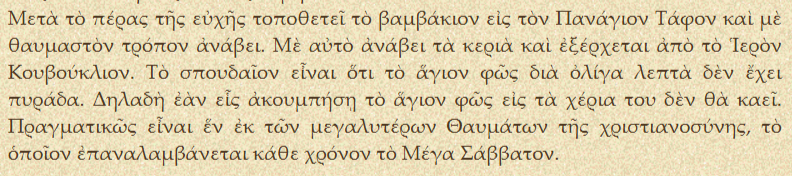
Equally widespread is the perception that, during the first few minutes, the flame does not burn. “The important point is that the Holy Fire does not possess a burning property for a few minutes,“ the Patriarchate had stated in the past (in English as well). The claim regarding the non-burning nature of the Holy Fire has been the subject of numerous “experiments,” all of which lack scientific rigor, as we have explained many times in the past in our relevant articles [Article 1] [Article 2][Article 3].
How is the Holy Fire actually lit?
The answer to this question is provided by the very individuals who participate directly or indirectly in the ceremony, such as the Sacristans of the Holy Sepulchre, Archbishops of the Holy Sepulchre Brotherhood, and guardians of the Holy Sepulchre, in interviews they granted to Dimitris Alikakos (author of the relevant book “Redemption – On the Holy Fire”, Εκκρεμές Editions, 2019).
1. Two oil lamps are placed inside the Holy Sepulchre
On the morning of Holy Saturday, around 8:30 a.m., the Guardian of the Holy Sepulcher enters the Edicule of the Holy Sepulchre, to place the Guardians’ oil lamp (Greek: kandíla, “κανδήλα”), a privilege held by the guardians as a blessing for them, but also as a “safety net”, as explained by Archbishop Isidoros, the current Sacristan of the Holy Sepulchre, in his historical testimony to Dimitris Alikakos.
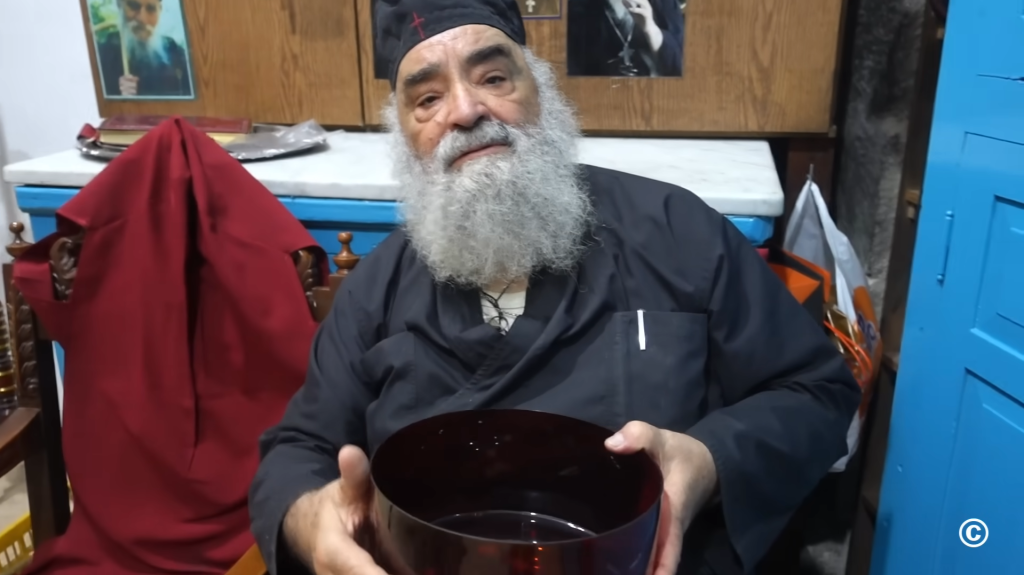
Watch here the testimony of the late monk Panteleimon, the senior of the Temple’s Guardians. The video also shows the exact spot where the oil lamps (Greek: kandíles) are placed inside the Holy Sepulchre (the full testimony is available in YouTube with English subtitiles here):
After the Guardian leaves, the door of the Holy Edicule is sealed by the Temple’s gatekeeper with soft wax, in remembrance of: “they sealed the stone along with the tomb” (Matt. 27:66). The wax seal is then removed, and it is not the Patriarch who enters, but the Sacristan, carrying the “perpetual vigil lamp” (Greek: akímēti kandíla).
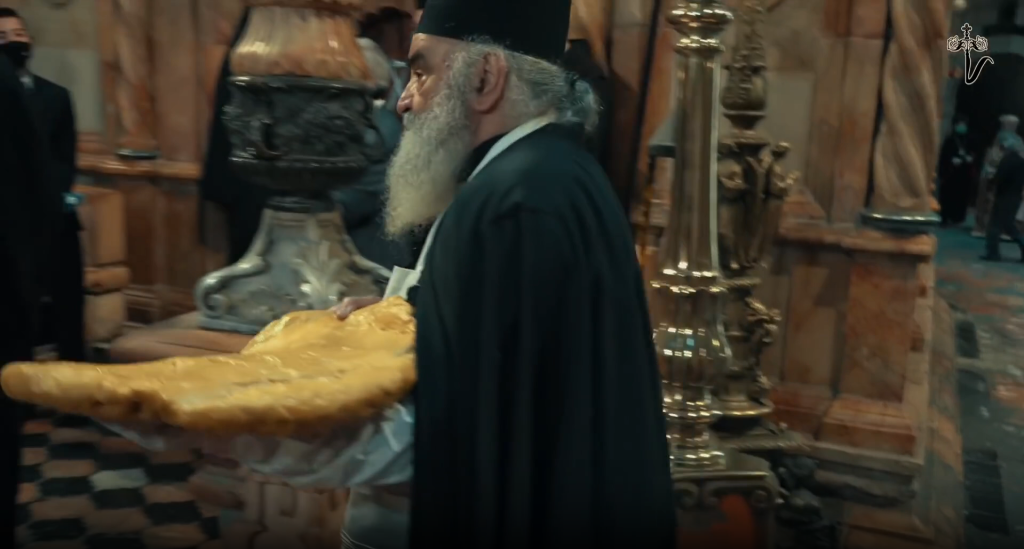
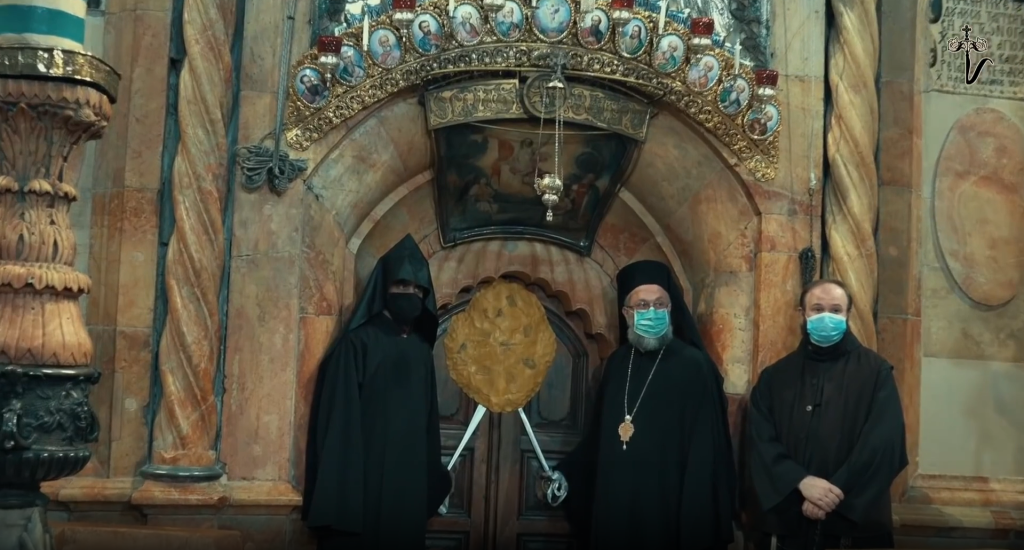
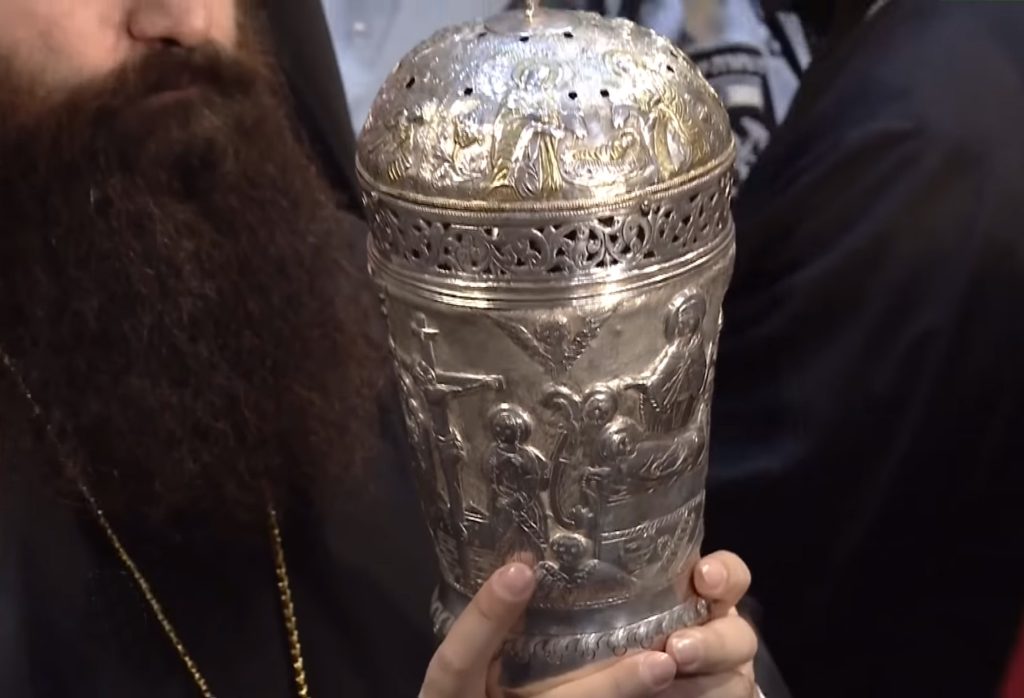
During the ceremony of the Holy Fire, at noon, the first person to enter the Holy Sepulchre is the Sacristan, who carries with him the so-called “perpetual vigil lamp” (Greek: akímēti kandíla), a metal oil lamp which remains permanently unlit and is lit only every Holy Saturday, as explained by Archbishop Isidoros.
2. The sacristan enters first and lights the two kandíles so that the Patriarch will find them lit
At the time of the ceremony, then, the Sacristan enters the Holy Edicule first, carrying the unlit metal lamp, also known as the “perpetual vigil lamp“. He lights both this lamp and the custodians’ lamp, so that the Patriarch finds them already lit when he enter, as Archbishop Isidoros reveals. “I light them both. The second one as a safeguard“. See his historical testimony (the full interview, with English subtitles, is available in YouTube here):
At this point, it becomes clear that the Patriarch is not the first to enter the Holy of Holies. Furthermore, it is not true that the Patriarch is searched by Israeli authorities or representatives of other denominations to ensure that he is not carrying any object that could be used to light a fire, as Patriarch Theophilos III himself has stated and as we have explained in a previous article.
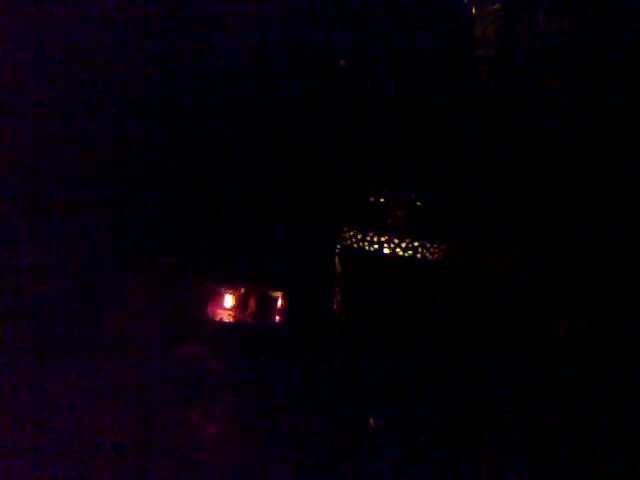
Consequently, when the Patriarch enters the Holy Sepulchre, he finds two candles lit. This fact is further reinforced by the following revealing video, in which we see the following: as the Patriarch enters the Holy Sepulchre, one candle appears to be already lit, its flame smoldering on the Tombstone.
What follows is a prayer of thanksgiving by the Greek Orthodox Patriarch and the Armenian priest before the Holy Sepulchre. The flame is then taken from one of the two lit lamps. The Holy Fire is subsequently distributed first through the two openings of the Edicule –on the right (by the Orthodox Patriarch) and on the left (by the Armenian priest)– and then the Patriarch and the Armenian priest exit the Edicule, after which the Holy Fire is distributed among the faithful.
After the conclusion of the Holy Fire ceremony, and the exit first of the Greek Orthodox Patriarch and then of the Armenian priest, video footage confirms that both candles are lit (at 1:32):
3. How the Holy Fire is lit
So, how is the Holy Fire lit? The answer given by the key participants in the Holy Fire Ceremony is consistent across all historical, video-recorded testimonies: The Holy Fire is lit naturally.
The first historical testimony of Metropolitan Cornelius of Petra†: “It is lit naturally“
Metropolitan Cornelius of Petra arrived in Jerusalem in 1951. In 2001, as the eldest of the Holy Sepulchre Monks, he was the one who brought the Holy Fire out of the Holy Sepulchre on Holy Saturday and had firsthand experience of how it is lit. In his historically first testimony to Dimitris Alikakos –having the experience of the Lighting– Cornelius explains that when he entered the Holy Sepulcher, a lit kandíla was already in place and he affirms that the Holy Fire” is lit naturally”, clarifying that “there is no miracle”, but rather a ceremony of consecration. Watch the testimony (available in YouTube with English subtitles):
As Metropolitan Cornelius explains, the method of the Lighting the Holy Fire is passed from one Sacristan to another through an oral tradition. This practice is confirmed both by Archbishop Isidoros in his own testimony and by former Archbishop Nikiforos, as heard in the following testimony.
Testimony of former Sacristan Nikiforos: “I lit it with matches“
Former Archbishop Nikiforos of Askalon served as Sacristan at the Church of the Holy Sepulchre for four years, from 1984 to 1988. In his interview, he states: “I placed the eternal oil lamp in the Holy Sepulchre and lit it myself with matches”. The former Sacristan dismisses the “miracle,” arguing that the fact it is presented on the website of the Patriarchate of Jerusalem constitutes a “fraud.”
Excerpts from an earlier Greek version of the Patriarchate’s website from 2010:


Watch his testimony (available only in Greek):
Testimony of Archbishop Theophanes of Gerasa, a member of the Holy Sepulchre Brotherhood: “It is natural light“
Archbishop Theophanes arrived in Jerusalem in 1961 and in 2005 was a candidate for the Patriarchal Throne and former Exarch of the Holy Sepulchre in Athens. In a video, where he addresses a group of faithful in the presence of Dimitris Alikakos, the Archbishop clarifies that the Holy Fire ceremony is neither a Sacrament nor a liturgical service of the Church, but merely a simple, symbolic, local rite. (The video is available in Youtube with English subtitles).
According to Archbishop Theophanes, this ceremony was first described as a “miracle” by the Crusaders, during a particularly turbulent period when Jerusalem was under siege by the Muslims, with the Holy Sepulchre Monks never correcting this perception, which strengthened over the centuries. “They never tell them the truth.“
Regarding the manner in which the Holy Fire is lit, he clarifies that “it is natural light” and that “no light descends from heaven.” Referring to the Patriarch’s ritual, he explains: “There is a perpetual lamp in the Holy Sepulchre. He reads a very beautiful theological prayer. He lights the lamp and gives the light to the people. It is natural light, but sanctified.”
Of historical significance is also the sworn testimony of Archbishop Theophanes, in the context of the lawsuits filed by Archbishops Aristarchos and Isidoros against Dimitris Alikakos, in which Theophanes emphasizes once again that “the one and only truth about the Holy Fire is that it is natural light sanctified by the prayer recited by the Patriarch” (the full testimony is available here in Greek). We quote an excerpt from Archbishop Theophanes’ testimony:
“I am Archbishop Theophanes of Gerasa, born Theophanes Chasapakis, and I have served at the Patriarchate of Jerusalem since 1961 […] I met the journalist Dimitris Alikakos on July 2, 2018, when he arrived in Jerusalem with a clear interest in learning everything about the Descent of the Holy Fire, which takes place every year on Holy Saturday at the Church of the Holy Sepulchre. […] Everything I told him, as well as my sermon at the Church of the Holy Sepulchre, I saw written verbatim in his book “Redemption – On the Holy Fire.” In it, he recorded, with respect for the faith and the Patriarchate, the one and only truth about the Holy Fire, namely that it is natural light, which is sanctified by the blessing read by the Patriarch.”
Testimony of Isidoros, current Sacristan of the Holy Sepulchre: “How the lamp is lit is not a miracle”:
Archbishop Isidoros: There are two matters: How the holy oil lamp is lit and how it is sanctified. These are two different things.
D. Alikakos: Correct. How it is sanctified, since the Divine Grace descends, is a miracle.
Archbishop Isidoros: Yes, in this sense of miracle.
D. Alikakos: But how it lights up is not a miracle.
Archbishop Isidoros: No, of course it’s not a miracle.
Watch the full interview here, available with English subtibles.
The court ruling: “Through human intervention”
On February 26, 2026, the Athens Single-Judge Court of First Instance ruled that the Holy Fire is lit “through human intervention,” that is, “with a lighter or matches.” This is the latest ruling in a series of trials that followed the publication of Dimitris Alikakos’s book “Redemption – On the Holy Fire.” The court was called upon to rule on the claims of the plaintiff, the Chief Secretary of the Patriarchate of Jerusalem, Archbishop Aristarchos, regarding defamation and misrepresentation of statements and insult to character, rejecting all claims and vindicating Dimitris Alikakos’s journalistic investigation and methodology.
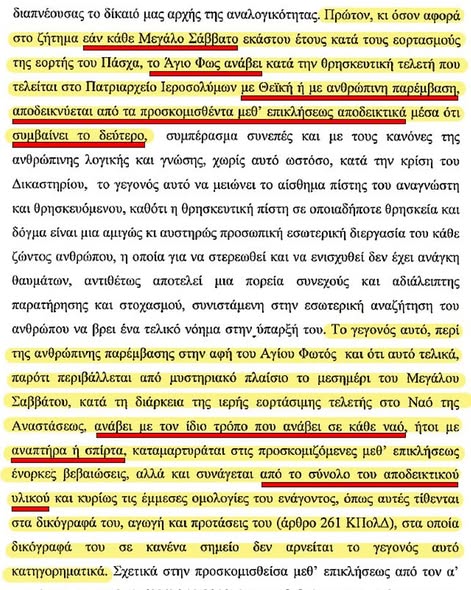
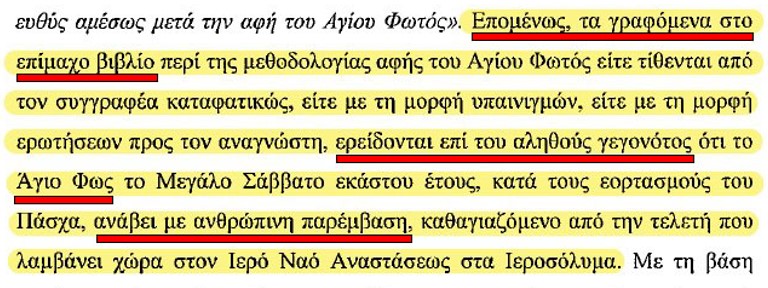
Here is the full decision (in Greek). Specifically regarding the manner of the lighting of the Holy Fire, the court states the following in its decision:
“First, regarding the question of whether every Holy Saturday of each year during the Easter celebrations, the Holy Fire is lit during the religious ceremony held at the Patriarchate of Jerusalem through divine or human intervention, it is proven by the evidence submitted upon request that the latter is the case, a conclusion consistent with the rules of human logic and knowledge, without, however, in the Court’s judgment, this fact diminishing the sense of faith of the reader and the religious believer, since religious faith in any religion or doctrine is a purely and strictly personal internal process of every living human being, which, in order to be established and strengthened, does not require miracles, but rather constitutes a path of continuous and uninterrupted observation and reflection, consisting of man’s inner quest to find a final meaning in his existence”.
The Patriarchate of Jerusalem removes the word “miracle”
On June 23, 2018, the Patriarchate of Jerusalem removed the word “miracle” from its official texts and deleted the relevant entry (both in Greek and in English) regarding the Holy Fire from its website, where until then its appearance had been presented as a miracle, as a miraculous “spontaneous combustion” of cotton. To this day, this entry remains inactive.
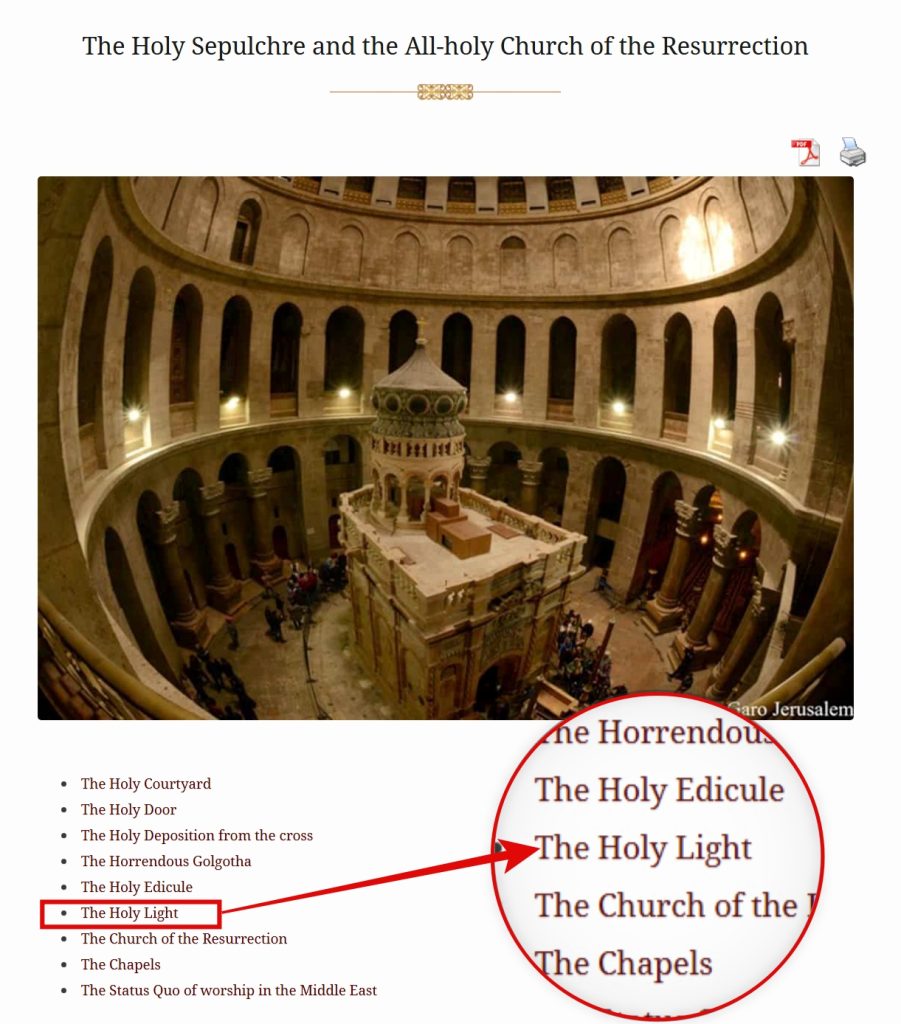
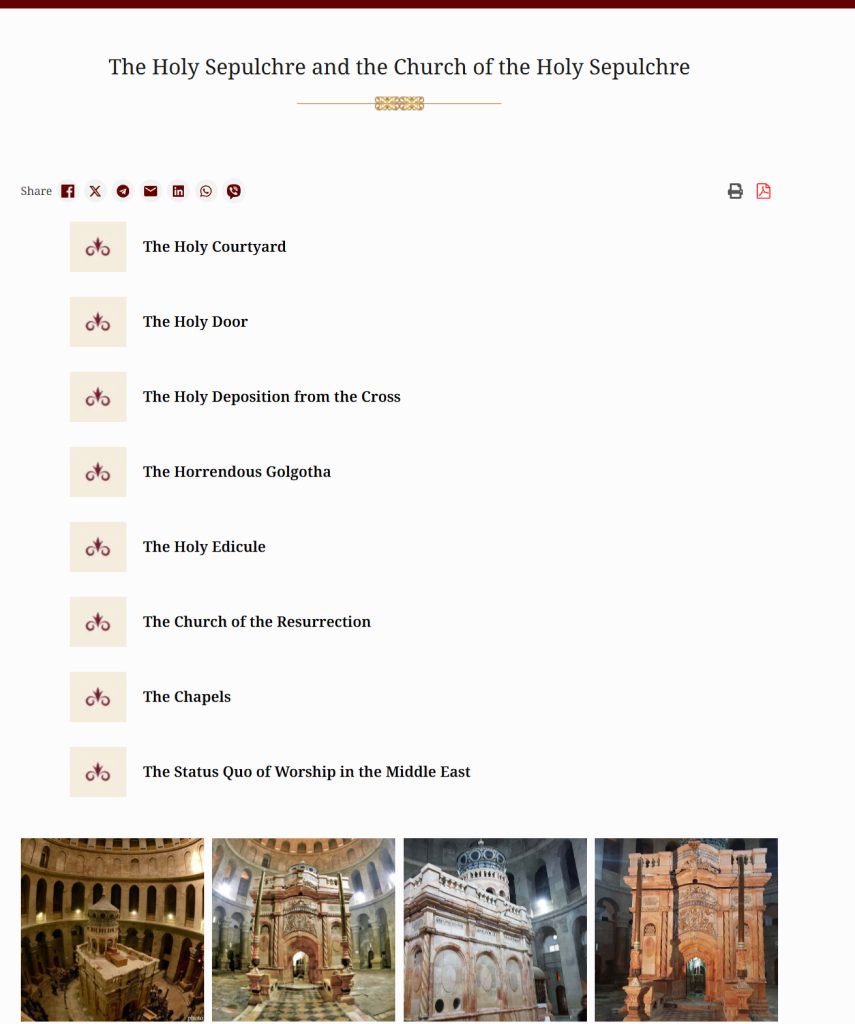
Following Dimitris Alikakos’s research, the Patriarchate of Jerusalem ceased to officially refer to the Holy Fire as having a supernatural and miraculous origin. Examples here here, here, here, here.
On July 3, 2018, a few days after the word “miracle” was removed from the Patriarchate’s website, the current Patriarch Theophilos III told Dimitris Alikakos:
“That text shouldn’t have been there… But the Patriarchate doesn’t speak of miracles! The word comes from ‘to marvel.’ What connection could it possibly have with a sacred ceremony?”
The answer, after all, lies in the thanksgiving prayer itself that the Patriarch reads upon entering the Holy Sepulcher, where, through the phrase “from Your light-bearing Tomb, where light burns continuously and eternally“, there is an explicit reference to the “ever-burning lamp” from which the Holy Fire is kindled, as noted by former Archbishop Nikiforos. The relevant part of the prayer follows:
Ἐπειδὴ γὰρ τῇ σωτηρίῳ καὶ φωταυγεῖ νυκτὶ πάντα πεπλήρωται φωτός, οὐρανὸς τὲ καὶ γῆ καὶ τὰ καταχθόνια, διὰ τὸ ὑπερφυὲς μυστήριον τῆς ἐν Ἅδου καθόδου σου καὶ τῆς ἐκ Τάφου σου τριημέρου ἀναστάσεως. Διὰ τοῦτο ἐκ τοῦ ἐπὶ τοῦτον τὸν φωτοφόρον σου Τάφον ἐνδελεχῶς καὶ ἀειφώτως ἐκκαιομένου φωτὸς εὐλαβῶς λαμβάνοντες διαδιδόαμεν τοῖς πιστεύουσιν εἰς σὲ τὸ ἀληθινὸν φῶς καὶ παρακαλοῦμεν καὶ δεόμεθά σου, Πανάγιε Δέσποτα, ὅπως ἀναδείξῃς αὐτὸ ἁγιασμοῦ δῶρον καὶ πάσης θεϊκῆς σου χάριτος πεπληρωμένον διὰ τῆς χάριτος τοῦ Παναγίου καὶ φωτοφόρου Τάφου σου καὶ τοὺς ἁπτομένους εὐλαβῶς αὐτοῦ εὐλογήσῃς καὶ ἁγιάσῃς.
[Translation in English: For since salvation and the light of the night have filled all things with light, heaven and earth and the underworld, through the surpassing mystery of your descent into Hades and your resurrection on the third day from your Tomb. For this reason, from your light-bearing Tomb, which burns with an unceasing and everlasting light, we reverently receive and spread to those who believe in you the true light, and we beseech and pray to you, All-Holy Lord, that You may reveal this gift of sanctification, filled with all Your divine grace, through the grace of Your All-Holy and Light-bearing Tomb, and that You may bless and sanctify those who touch with reverence, bless and sanctify them.]
The phrase “which burns with an unceasing and everlasting light“, which may shed light on the true nature of the ceremony, had been misleadingly omitted from both the Greek and English entry that existed until 2018 on the website of the Patriarchate of Jerusalem.
Conclusion
The centuries-old belief that the Holy Fire is lit in a miraculous manner is now refuted by historical testimonies from the very protagonists of the ceremony, as recorded in Dimitris Alikakos’s extensive research in Jerusalem.
According to the senior Guarding of the Holy Sepulchre, early on the morning of Holy Saturday, he himself places the first kandíla in the Tomb. At the start of the ceremony, the first to enter is the Sacristan, holding a second metal kandíla, known as the “ever-burning” one, which in reality remains unlit throughout the year.
The current Sacristan, Archbishop Isidoros, publicly admitted that he lights the two kandíles himself so that the Patriarch finds them already lit, clarifying that the process does not constitute a miracle. His predecessor, former Archbishop Nikiforos, confirmed exactly the same practice, describing how he lit the candle with matches before the Patriarch’s entrance.
These revelations are corroborated by testimonies from other prominent Holy Sepulchre officials. The late Metropolitan Cornelius, who brought out the Holy Fire in 2001 as locum tenens of the patriarchal throne, reported that he lit his kandíla from an already lit oil lamp, explicitly stating that “there is no miracle.” Along the same lines, Archbishop Theophanes confirmed in a recorded speech –well as in sworn testimony he gave– that “the Holy Fire is lit from an oil lamp,” adding characteristically that “everyone in the brotherhood knows the truth, but they don’t say it.”
Beyond the verbal testimonies, there is irrefutable visual evidence showing the Patriarch entering the antechamber of the Tomb, where a flame is already visible. It is also telling that, during the journalistic investigation in 2018, the Patriarchate of Jerusalem tacitly removed the term “miracle” from its official texts.
All of the above facts formed the core of the evidence on which the recent and historic decision of the Greek courts was based. The Athens Single-Judge Court of First Instance ruled that the Holy Fire is lit “through human intervention,” and specifically “with a lighter or matches.”
Thus, a ceremony that for centuries was shrouded in the aura of the supernatural is demystified by the very lips of its protagonists. The truth of human intervention is no longer merely an assertion, but a proven fact, institutionally validated by a court ruling.
Originally published in Greek, on April 10, 2026. Available here.
Sources used:
- https://www.holyfirethetruth.com/
- https://www.youtube.com/@HolyFireTheTruth
- https://el.wikipedia.org/wiki/%CE%86%CE%B3%CE%B9%CE%BF_%CE%A6%CF%89%CF%82#%CE%A4%CE%B5%CE%BB%CE%B5%CF%84%CE%BF%CF%85%CF%81%CE%B3%CE%B9%CE%BA%CF%8C:~:text=%CE%91%CE%BD%CE%AC%CF%83%CF%84%CE%B1%CF%83%CE%B7%CF%82%20%CF%84%CE%BF%CF%85%20%CE%A7%CF%81%CE%B9%CF%83%CF%84%CE%BF%CF%8D.-,%CE%91%CF%86%CE%AE%20%CF%84%CE%BF%CF%85%20%CE%91%CE%B3%CE%AF%CE%BF%CF%85%20%CE%A6%CF%89%CF%84%CF%8C%CF%82%20%CF%83%CF%84%CE%BF%20%CE%9D%CE%B1%CF%8C%20%CF%84%CE%B7%CF%82%20%CE%91%CE%BD%CE%B1%CF%83%CF%84%CE%AC%CF%83%CE%B5%CF%89%CF%82,-%5B%CE%95%CF%80%CE%B5%CE%BE%CE%B5%CF%81%CE%B3%CE%B1%CF%83%CE%AF%CE%B1%20%7C
- https://el.wikipedia.org/wiki/%CE%9D%CE%B1%CF%8C%CF%82_%CF%84%CE%B7%CF%82_%CE%91%CE%BD%CE%B1%CF%83%CF%84%CE%AC%CF%83%CE%B5%CF%89%CF%82
- https://www.proseyxi.com/i-euxi-tou-agiou-fotos/
- https://web.archive.org/web/20160413063622/http://www.jerusalem-patriarchate.info/main/page/%CE%B1%CE%B3%CE%B9%CE%BF-%CF%86%CF%89%CF%82
- https://archive.ph/2018.06.19-202629/http://jerusalem-patriarchate.info/%CF%80%CE%B1%CE%BD%CE%AC%CE%B3%CE%B9%CE%BF%CF%82-%CF%84%CE%AC%CF%86%CE%BF%CF%82-%CF%80%CE%B1%CE%BD%CE%AF%CE%B5%CF%81%CE%BF%CF%82-%CE%BD%CE%B1%CF%8C%CF%82-%CF%84%E1%BF%86%CF%82-%E1%BC%80%CE%BD%CE%B1/%CF%84%CF%8C-%E1%BC%85%CE%B3%CE%B9%CE%BF-%CF%86%E1%BF%B6%CF%82/
- https://www.ellinikahoaxes.gr/2019/04/08/peirama-volkof/
- https://www.ellinikahoaxes.gr/2019/05/03/the-holy-light-does-not-burn-for-a-few-minutes-misinformation/
- https://www.ellinikahoaxes.gr/2023/04/28/holy-light-new-and-old-hoaxes/
- https://www.ellinikahoaxes.gr/2021/04/27/ochi-kaneis-den-psachnei-ton-patriarchi-ierosolymon-prin-tin-teleti-afis-tou-agiou-fotos/
- https://web.archive.org/web/20181228180311/http://en.jerusalem-patriarchate.info/the-holy-sepulcher-and-the-all-holy-church-of-the-resurrection/the-holy-light/